Who it is for
Homeowners with a roof past economic repair, landlords who are tired of repeat call-outs, buyers whose survey has flagged the roof, and commercial property owners who need the building watertight without weeks of disruption.

Services · New Roof Installations
A full re-roof from a family firm that has been on Surrey roofs for three generations: surveyed properly, priced in writing, staged payments, and a 25-year guarantee on the finished pitched roof.
Free survey for homeowners · 25-year pitched roof guarantee · £1,000,000 public liability cover
We run 24/7 emergency cover. A £150 call-out gets a roofer to the property to make it safe and stop the water, with the repair priced before any further work.
Call 07808 839833Emergency line answered day and night
Recent New Roof Installations
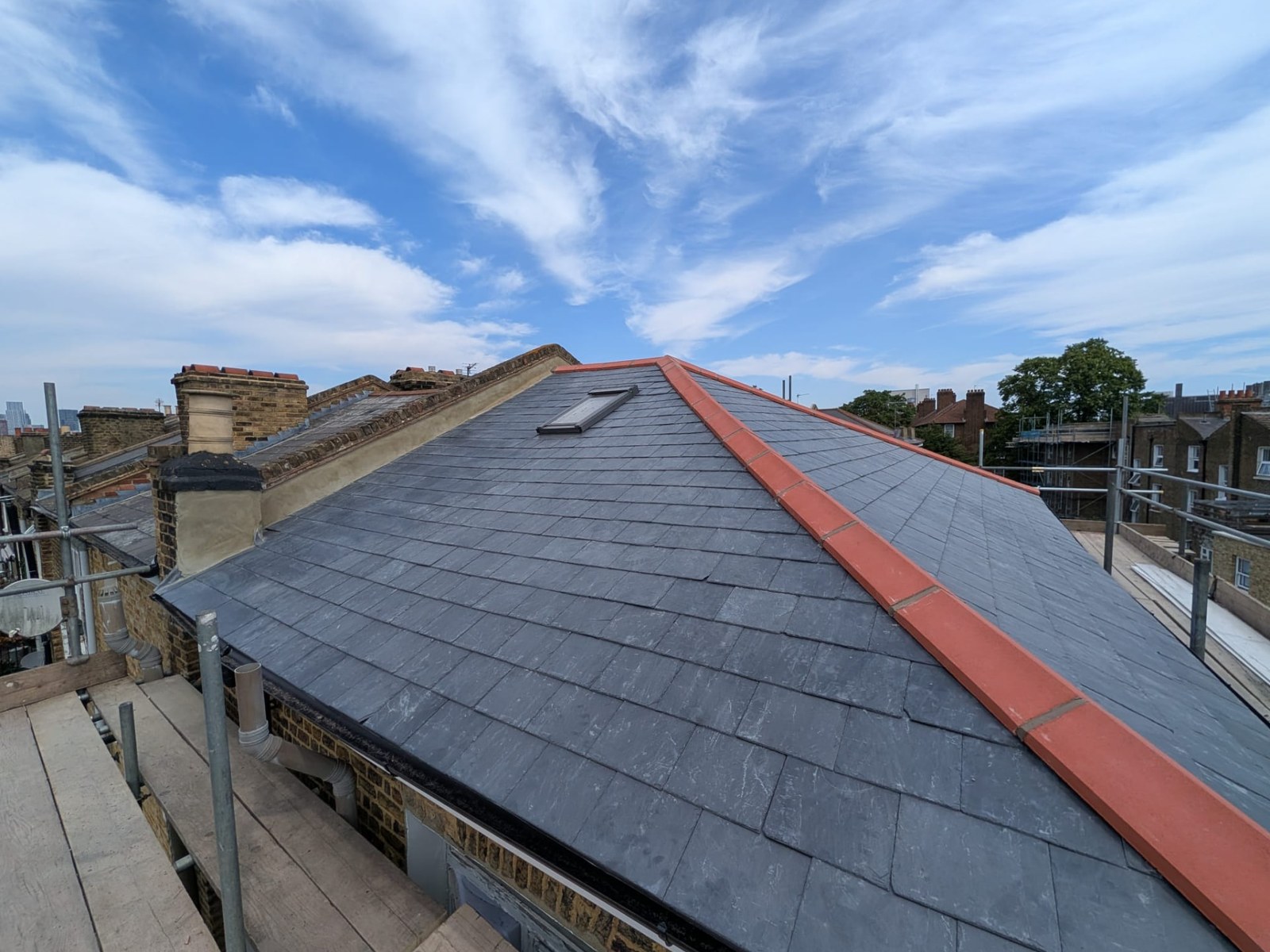
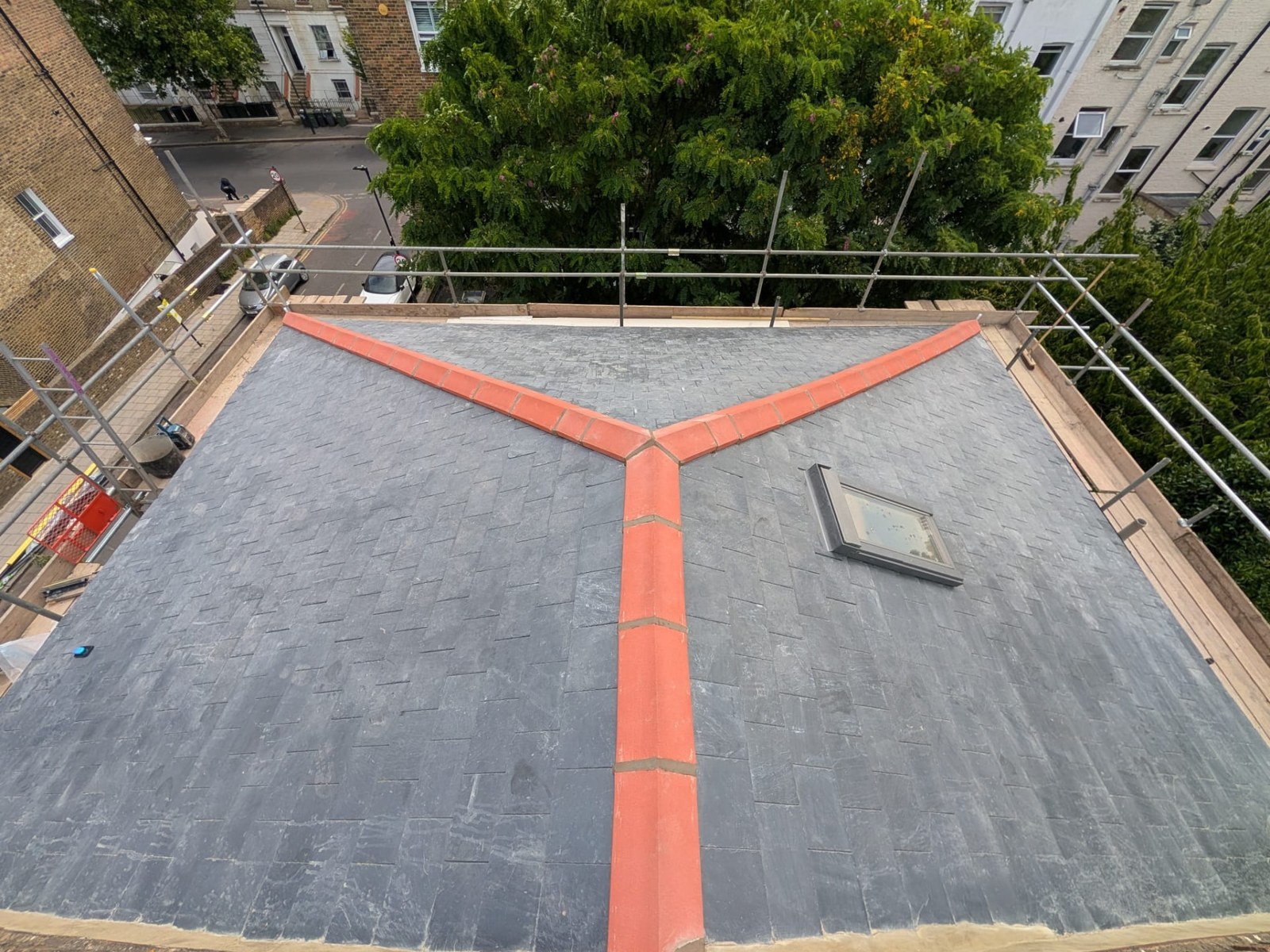
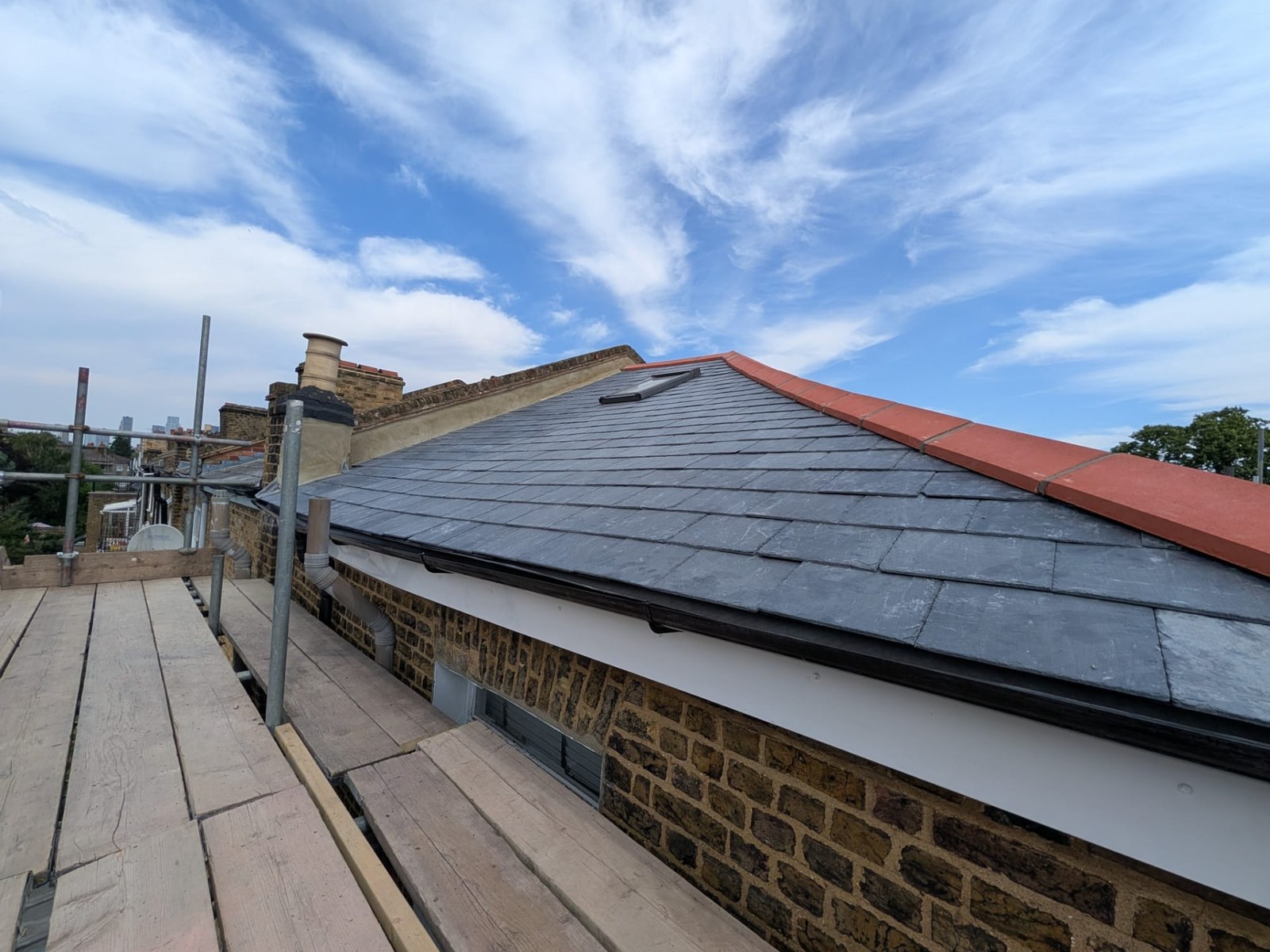
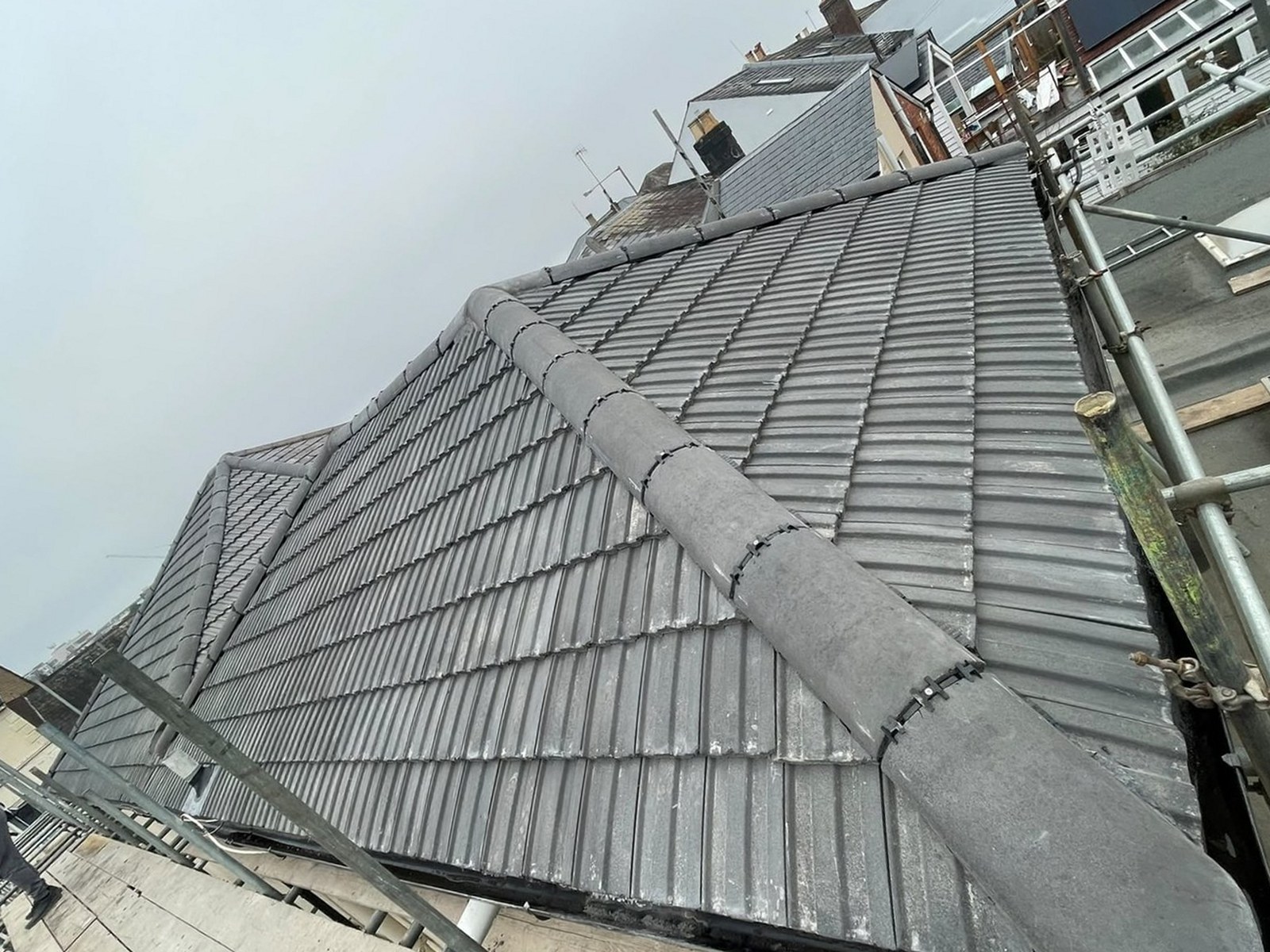
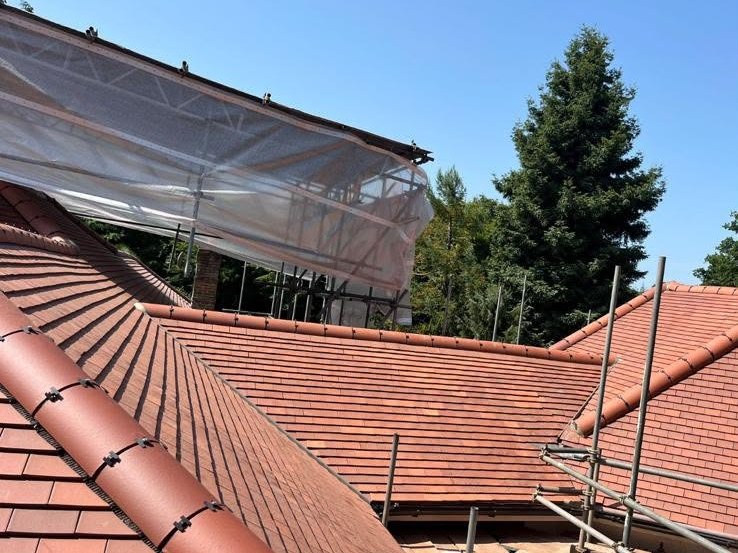
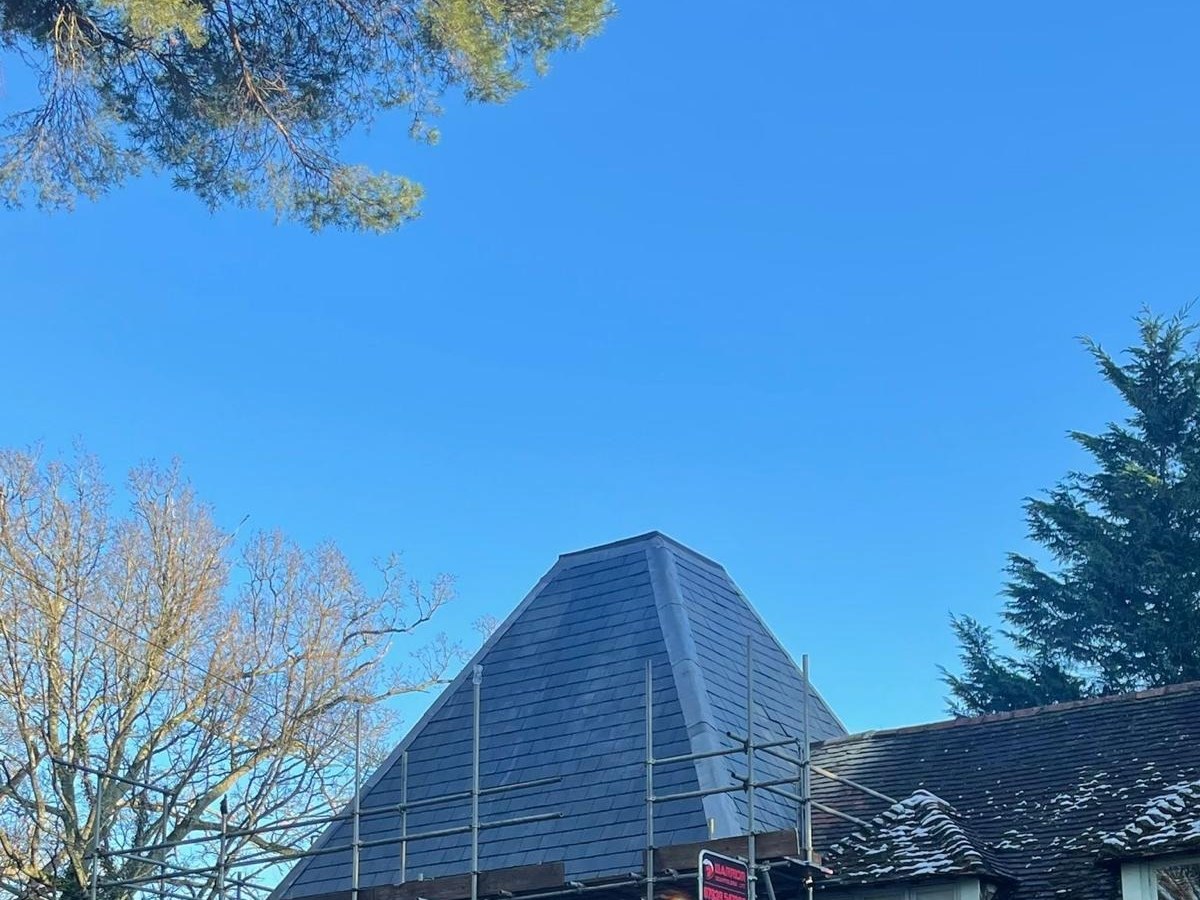
Overview
A new roof installation is a full replacement of the roof covering and everything underneath it that has stopped doing its job. The old tiles or slates come off, the battens and felt come off with them, the timbers are inspected while they are exposed, and the roof is rebuilt from the deck up with new membrane, new battens, new fixings, fresh leadwork and new tiles or slates. It is the only point in a roof's life when the structure can actually be seen, so it is also the point at which hidden rot, split rafters and failed historic repairs get found and dealt with rather than covered over for the next owner.
We install all pitched roof systems except metal roofing: concrete and clay plain tiles, interlocking tiles, natural and fibre cement slate, and the associated ridge, hip, valley and verge details. Flat sections, dormer tops and back additions are covered by our flat roofing systems, so a house that mixes pitched and flat areas is handled by one team on one quote rather than split between trades who each blame the other when water appears.
Every pitched roof we install carries a 25-year guarantee. Flat roof installations carry a 15-year guarantee, and the flat roofing systems also come with a manufacturer-backed guarantee that is passed on to you in writing. That is the whole point of a new roof: you should not have to think about it again for decades, and the paperwork should say so.
Homeowners with a roof past economic repair, landlords who are tired of repeat call-outs, buyers whose survey has flagged the roof, and commercial property owners who need the building watertight without weeks of disruption.
When repairs are becoming annual rather than occasional, when tiles are delaminating or slates are nail-sick across the whole slope, when the felt has perished and daylight shows through in the loft, or when insulation and ventilation upgrades make a partial fix a false economy.
A roof fails at its details, not in the middle of a slope. Valleys, abutments, chimney flashings, verge and eaves ventilation are where water finds its way in, and those are the parts a price-driven install cuts corners on. Our leadwork is hand-dressed and welded by roofers who do it every week.
A written quote listing materials and scope, a staged payment schedule (on a new pitched roof, typically a 30% deposit once the scaffolding is up, with the balance staged through the job), and the guarantee documentation at handover.
What Goes Wrong
A roof rarely fails suddenly. It leaks quietly into timber and plaster for a season or two before anything shows on a ceiling, which is exactly why replacement costs escalate the longer the decision is delayed.
Once a covering is generally worn out, each repair moves the weak point somewhere else. Three or four call-outs a year add up to a meaningful share of a replacement while the roof continues to deteriorate.
Water tracking down a rafter rots the timber it soaks. Replacing rafters, purlins or a wall plate is joinery work on top of roofing work, and it is only found once the covering comes off.
Wet loft insulation stops insulating and starts holding moisture against the ceiling below. Heating bills rise, plaster stains, and mould appears in the rooms furthest from the actual leak.
A surveyor's report that flags a roof at the end of its life either kills a sale or knocks a five-figure sum off the price — usually more than the work would have cost to do properly.
How It Works
We get onto the roof and into the loft, photograph the covering, timbers, felt and flashings, and establish whether a replacement is genuinely the right call. If a repair will buy you five more good years, we will say so.
You get a written scope: covering, membrane, battens, leadwork, ventilation, scaffolding and waste removal, priced item by item. Free for homeowners; £150 for a pre-purchase survey, deducted from your quote if you proceed.
Dates are agreed before anything is ordered. Scaffolding goes up first, access and neighbour arrangements are sorted, and the deposit falls due at that point rather than at the point of signing.
The old covering is stripped and removed, timbers are inspected while exposed and any defects reported to you with photographs before they are repaired. The roof is then rebuilt with new membrane, battens, fixings, leadwork and covering.
We walk the finished roof with you, check the loft for daylight and ventilation, clear the site, and hand over your 25-year pitched roof guarantee documentation with the final staged payment.
What You Get
A correctly detailed pitched roof is a multi-decade asset, and ours is backed for 25 years in writing rather than by a handshake.
A written, itemised quote and a staged payment schedule mean you know the number before work starts and you are never handing over large sums against work not yet done.
Scaffolded access, £1,000,000 public liability cover, and a crew trained in-house on our own sites rather than assembled from whoever was available that week.
New membrane and correct eaves and ridge ventilation stop condensation forming in the roof space, which protects both timber and insulation performance.
Photographs, written scope and guarantee documentation give a buyer's surveyor something concrete to look at instead of a question mark.
Pitched, flat, leadwork and chimney details handled by the same team, so nothing falls between two trades at the junctions where roofs actually leak.
In Detail
Roof replacement is not one product. The right specification depends on the pitch, the exposure, the existing structure and what the property looks like next to its neighbours.
Concrete interlocking tiles remain the workhorse of suburban London and Surrey roofs: fast to lay, economical, and well suited to the 22-degree-plus pitches on most post-war housing. Plain tiles, clay or concrete, are the traditional choice on older Morden and Merton stock and on any roof with complex hips and valleys, because small units follow shape far better than large ones.
Natural slate suits Victorian and Edwardian properties and steeper pitches, laid on treated battens with copper or aluminium nails. Fibre cement slate gives a similar line at lower weight and cost, which matters on roofs whose original structure was never designed for a heavy covering.
Modern breathable membrane replaces the perished bitumen felt found on most pre-1990 roofs, allowing water vapour out while keeping wind-driven rain from reaching the timber. It is supported and counter-battened where the design requires it rather than left to sag between rafters.
Battens are new on every full installation, graded and treated, set to the correct gauge for the covering. Fixing specification changes with exposure: clipped and nailed perimeter courses, mechanically fixed dry ridge and dry verge systems in place of mortar bedding that cracks and drops within a decade.
Valleys are formed in lead or with a proprietary valley system depending on the roof, with the covering cut and supported cleanly rather than bedded on mortar. Abutments to walls and chimneys are flashed with hand-dressed lead, stepped into raked joints and pointed, and welded where the geometry demands it.
Dry verge and dry ridge systems remove the single largest cause of call-outs on older re-roofs — failed mortar. Where a property's character requires a mortar-bedded finish, it is bedded onto mechanically fixed units so the mortar is decorative rather than structural.
A sealed modern roof over an under-ventilated loft creates condensation, which does the same damage as a leak more slowly. Eaves ventilation, ridge ventilation or tile vents are specified as part of the installation, sized to the roof rather than added as an afterthought.
Where loft insulation is being upgraded at the same time, the ventilation path at the eaves must be maintained. We coordinate the two so insulation is not stuffed into the eaves and choking the airflow the new membrane relies on.
On homes the priorities are appearance, disruption and neighbour access — narrow Morden side returns, shared drives and parking all shape how scaffolding is planned and how long the roof stays open.
On commercial buildings the priorities are continuity of use and larger flat or low-pitch areas. Works are phased so the building stays operational, temporary weatherproofing is planned into the programme, and large flat areas are specified as full flat roofing systems rather than patched pitched details.
We are based at 48 Buckfast Road in Morden and work across Greater London, Surrey, Kent, West and East Sussex, Hampshire, Reading and the Isle of Wight. Most re-roofs are within an hour of Morden, which keeps the same crew on your job from strip to sign-off.
Where We Work
Questions
If your question is not here, call 07808 839833 and speak to a roofer rather than a call centre.
Price depends on the size and shape of the roof, the covering you choose, the scaffolding required and the condition of the timbers underneath. We will not quote blind over the phone. The survey and written quote are free for existing homeowners, and the quote is itemised so you can see what each part of the job costs.
A typical semi-detached or terraced house roof is usually a matter of days rather than weeks once scaffolding is up. Complex roofs with multiple hips, valleys, dormers or timber repairs take longer. You will be given a programme with your quote and told immediately if a hidden defect changes it.
New pitched roof installations carry a 25-year guarantee. Flat roof installations carry a 15-year guarantee, plus the manufacturer-backed guarantee on the flat roofing system itself, which is passed on to you.
Payments are staged and set out in writing before work begins. On a new pitched roof, for example, a 30% deposit is due once the scaffolding is up, with the balance staged through the job. You are not asked for large sums in advance of work being done.
No. The house stays occupied. The roof is opened in sections and made weathertight at the end of each working day, and we plan around access, parking and neighbours before the scaffolding arrives.
We photograph what we find, show you, and price the repair before carrying it out. Timber condition is the one thing nobody can see until the covering is off, so it is handled as a reported variation rather than assumed in either direction.
Yes. We hold £1,000,000 public liability cover and details are provided with every quote.
No. We install all pitched roof systems except metal. If metal is genuinely the right answer for your building we will tell you rather than sell you something else.
Yes, and it is often the right time to do it. We remove spray foam and reinstate the roof deck, and every removal we have carried out has been signed off by building control and surveyors without issue.
Yes. We run 24/7 emergency cover, and an open roof under our scaffolding is our responsibility — if weather turns overnight during your job, we deal with it.
Free Estimate
A free survey, an itemised written quote, staged payments and a 25-year guarantee on the finished pitched roof. No pressure, no obligation, no sales visit dressed up as an inspection.